Module One Assignments
OSI and TCP Layered Models
| Application | End user's access to the network; provides a set of utilities for application programs | HTTP, MIME, SMTP, DNS, FTP | Web applications, email, file transfer |
| Presentation | Formats the data for presentation to the user; accommodates different interfaces on different computers | TLS, AFP, JPEG, GIF | Images, embedded items |
| Session | Manages and structures all sessions; does session initiation and termination | RPC, SQL, NFS, SSH | Logical ports |
| Transport | Establishes, maintains, and terminates logical connections fro the transfer of data | TCP, UDP | Multiplexing |
| Network | Performs routing; determines where messages should be sent | IP | Routers |
| Data Link | Manages the physical transmission circuit and transforms it into a circuit that is free of transmission errors; performs error detection and correction and decides when a device can transmit | ATM, PPP, STP | Switches, bridges, WAPs |
| Physical | Physical connection between computers and/or devices in the network | Ethernet, DSL, 802.11 | Hubs, repeaters, cabling |
| Application | Application software used by the network user; user's access to the network | HTTP, MIME, SMTP, DNS, FTP | Web applications, email, file transfer |
| Transport | Links the application layer software to the network and establishes end-to-end connections between sender and receiver | UDP, TCP | Multiplexing |
| Internet | Allows exchange of information between hosts that are not attached to the same physical medium | IP | Routers |
| Link | Allows two hotsts that are directly connected through a physical connection to exchange information; the medium connecting these devices is used to transfer an electrical or optical signal between two directly connected devices | SLIP, PPP, Ethernet, DSL | Switches, bridges, hubs, cabling |
Questions
- By OSI layer, which group sets the standards for each OSI layer?
- Describe, by device, how information from your computer's keyboard at home gets out to the Internet. Specifically, describe each device and its function.
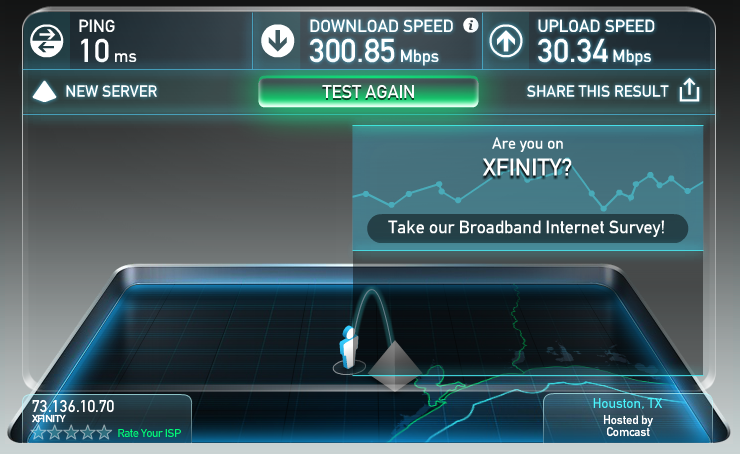
- Go to speedtest.net and test your Internet connection speed. Report that on your assignment.
Application Layer - IETF sets standards for HTML and SMTP.
Presentation Layer - Moving Picture Coding Experts Group sets standards for MPEG.
Session Layer - ANSI sets standards for SQL.
Transport Layer - IETF sets standards for TCP.
Network Layer - IETF sets standards for IP.
Data Link Layer - Groups such as IEEE and the EIA/TIA set standards at the data link layer.
Physical Layer - Groups such as ANSI, IEEE, and EIA/TIA set standards at the physical layer.
Information is input through the keyboard and processed by the computer's CPU. This information is then sent via Ethernet or wireless to the router, which routes the information to the appropriate destination. The information is then processed by the server, and then returns the requested information, if applicable, through the reverse steps.
Through my ISP Comcast, I get 300.85 Mbps download and 30.34 Mbps upload.
| Term | Definition |
| ANSI | An acronym for the American National Standards Institutde, a private non-profit organization that oversees the development of voluntary consensus standards for products, services, processes, systems, and personnel. |
| Backbone network | A larger, central network connecting several LANs, other BNs, MANs, and WANs; typically span from hundred of feet to several miles operating at 100 to 1000 Mbps. |
| Broadband | A wide bandwidth data transmission with an ability to simultaneously transport multiple signals and traffic types. In the context of Internet, the term 'broadband' is used to mean any high-speed Internet access that is always on and faster than dial-up access. |
| Circuit | Can have two meanings: in the context of a physical circuit, it is the actual wire used to connect two devices, and is the physical media that carries the message transmitted. In the context of a logical circuit, it means the transmission characteristics of the connection. |
| Client | The input-output hardware device at the user's end of a communication circuit tha tprovides users with access to the network and the data and software on the server. |
| Data link layer | The second layer of the OSI model; manages the physical transmission circuit and transforms it into a circuit that is free of transmission errors; performs error detection and correction and decides when a device can transmit. |
| Extranet | Uses the same technologies as the Internet, but instead is provided to invited users outside the organization who access it via the Internet. Can provide acceess to information services, inventories, and other internal organization databases. |
| FCC | Acronym for the Federal Communications Commission, an independent agency of the United States government. It regulates interstate communications by radio, television, wire, satellite, and cable. |
| Firewall | A network security system that monitors and controls the incoming and outgoing network traffic based on predetermined security rules. Typically establishes a barrier between a trusted, secure internal network and another outside network, such as the Internet, that is assumed not to be secure or trusted. |
| IEEE | Acronym for the Institutde of Electrical and Electronics Engineers, an organization best known for developing standards for the computer and electronics industry. |
| IETF | Acronym for the Internet Engineering Task Force, a non-profit organization that develops the standards for the protocols used in the Internet, mainly covering the transport and network layers. |
| ITU | Acronym for the International Telecommunication Union, a special agency of the United Nations that is responsible for issues that concern information and communication technologies. |
| Internet | A global system of interconnected computer networks that use the Internet protocol suite (TCP/IP) to link devices worldwide. It carries an extensive range of information resources awnd services. |
| Intranet | A >LAN that uses the same technologies as the Internet, but is open to only those inside the organization. |
| ISP | Acronym for Internet Service Provider, an organization that provides services for accessing and using the Internet. |
| KB | A unit byte of digital information, denoting 1024 bytes. |
| LAN | Acronym for Local Area Network, a group of computers located in the same general area. Cover a clearly defined small area and commonly operate at 100 Mbps. |
| Logical | Of or according to the rules of logic or formal argument; characterized by or capable of clear, sound reasoning. |
| Modem | Acronym for modulator/demodulator; translates the computer's digital data into analog data that can be transmitted through voice communication circuits. |
| Open system | The Open Systems Interconnection is a set of networking standards developed by the ISO, including the 7-layered OSI reference model. |
| Physical | The physical layer is concerned primarily with transmitting raw data bits over a communication circuit, and is the physical connection between the sender and receiver. |
| RFC | Acronym for Request for Comments, a formal document from the IETF that can be informational in nature, or are intended to become Internet standards. |
| Router | A device that connects two or more networks; operates in the network layer. |
| Switch | A relay that operates in the datalink layer. |
| VPN | Acronym for Virtual Private Network, which extends a private network across a public network, such as the Internet. Enables the user to send and receive data across shared or public networks as if their computing devices were directly connected to the private network. |
| WAN | Acronym for Wide Area Network, which can connect BNs and MANs. Typically span hundreds or thousands of miles and operate at 64 Kbps to 10 Gbps. |
| Wireless access point | A networking hardware device that allows a Wi-Fi compliant device to connect to a wired network. Usually connects to a router, or can be an integral component of the router itself. |