CCNA Wireless Guide Reading
The CCNA Wireless 200-355 certification guide provides coverage over a number of topics regarding wireless networks of all types. I will be providing a brief synopsis of Chapter 1 - RF Signals and Modulation.
The first section is Comparing Wired and Wireless Networks, and states the differences, advantages, and disadvantages among the two types of networks. A wired network, as the name implies, requires that any two devices that need to communicate be connected by a wire. Advantages include high speed and little interference with the signal, but suffer from an inability to move a wired device easily. Wireless networks remove the need for a device to be tethered to a wire or cable. They allow advantages such as convenience and mobility, but a disadvantage is having to combat the interference and noise that can disrupt a signal that does not have the protection of a wire.
As wireless networks are the focus of the book, it continues into the next section, Understanding Basic Wireless Theory. Since wireless signals are transmitted in a series of electromagnetic waves, it is important to understand the anatomy of a wave. Frequency is the number of times a signal makes one complete up and down cycle in one second, and is measured in hertz (Hz). For example, if a signal has 4 cycles per second, it would be said to have a frequency of 4 Hz.
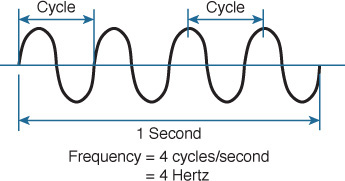
Within the range of frequencies present in the known universe, the range from 3 kHz to 300 GHz is known as the radio frequency (RF), which is where many types of communications transmit, including that of wireless LAN communication, which spefically function at 2.4- and 5-GHz. A frequency is divided into bands, which are divided into channels, and the width of these frequencies is referred to as their bandwidth.
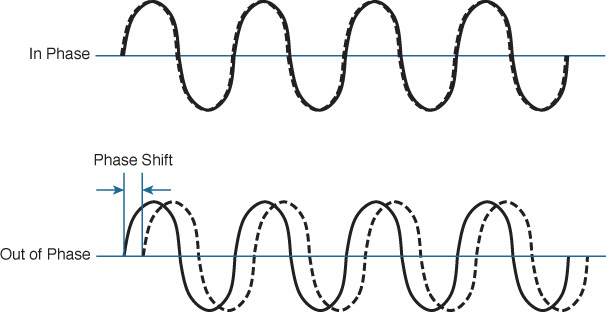
Another portion of a signal is its phase. The phase is a measure of the shift in time relative to the start of a cycle, and is measured in degrees. 0 degrees is the start of the cycle, and one complete cycle equals 360 degrees, with 180 degrees being the halfway point. Signals can be in phase, meaning that they are produced at identically and at the exact same time, so that their cycles match up; or they may be out of phase, meaning that one signal is delayed from the other. This can cause a garbled signal, but if signals are out of phase by 180 degrees, they cancel each other out completely.
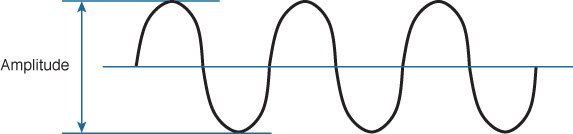
Also important is a signal's wavelength, indicated by the Greek letter λ. It measures the physical distance that wave travels over one complete cycle. Finally, amplitude is the measure of the height from the top peak to the bottom peak of the signal's waveform, is measured in watts (W), and is a measure of the signal's power. A signal's amplitude must be strong enough to overcome the noise floor.
The final section this chapter is titled Carrying Data Over an RF Signal, and explains spread spectrum, which is how LANs transmit signals over a wide range of frequencies. Spread spectrum has three categories, frequency-hopping spread spectrum (FHSS), direct-sequence spread spectrum (DSSS), and orthogonal frequency-division mulitplexing (OFDM). FHSS has generally fallen out of favor and is not often used today, however DSSS and OFDM are common. DSSS supports 1, 2, 5.5, and 11 Mbps data rates, while OFDM supports the highest data rates of all modulation types, with the exceptin of 6 and 9 Mbps.
These topics are signficant because it is important to know how and why different signals need different technologies to accommodate them, and learning the anatomy of a signal is imperative to understanding how the technology functions. Learning the different types of spread spectrums is also important because different 802.11 standards allow for use of different spectrum technologies.
I concluded this chapter by answering some questions for review, which can be found below.
- Which one of the following is the common standard that defines wireless LAN operation?
- Which of the following represents the frequency bands commonly used for wireless LANs? (Choose two.)
- Two transmitters are each operating with a transmit power level of 100 mW. When you compare the two absolute power levels, what is the difference in dB?
- A transmitter is configured to use a power level of 17 mW. One day it is reconfigured to transmit at a new power level 34 mW. How much has the power level increased in dB?
- Transmitter A has a power level of 1 mW, and transmitter B is 100 mW. Compare transmitter B to A using dB, and then identify the correct answer.
- The typical data rates of 1, 2, 5.5, and 11 Mbps can be supported by which one of the following modulation types?
IEEE 802.11
2.4 GHz and 5 GHz
0 dB
3 dB
20 dB
DSSS