Learning Portfolio Menu
Module Four Overview
Lessons Learned in Module Four
Module Four emphasized security and went into further detail on wireless networks. The first assignment in this module, the CCNA Wireless Guide Reading, took information from the CCNA Wireless 200-355 certification guide. This section was the most interesting to me and I will detail it further in the learning artifact below.
The subsequent assignments focused on security, beginning with Professor Messer's video on Security+. This introduced the concept of the AIC triad, which encompasses availability, integrity, and confidentiality. Each part of the triad can be achieved through different methods, which are detailed in the assignment. This module further expanded on security in covering chapter 11 of Business Data Communications and Networking, defining key terms related to network security.
Security is one of the fastest evolving landscapes within information technology and learning more about it is imperative to my future career within the field. The videos and reading associated with the topic provided an important understanding and introduced new concepts.
Learning Artifact
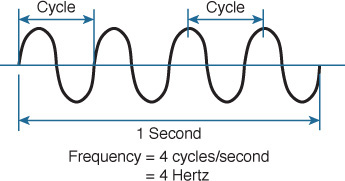
In the CCNA Wireless Guide Reading, basic wireless theory was introduced, which gave detailed information about the anatomy of the electromagnetic waves that allow wireless networks to function. Frequency, illustrated below, is the number of times a signal makes one complete up and down cycle in one second.
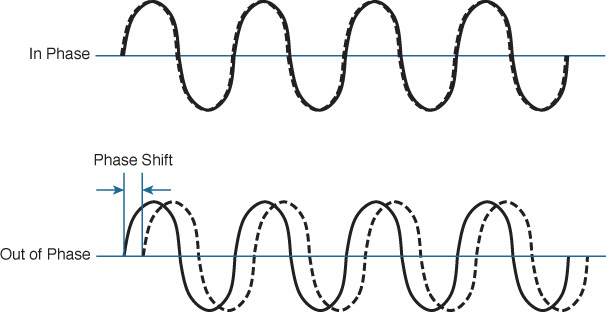
Phase is another part of the wave, which is the measure of the shift in time relative to the start of a cycle, and is measured in degrees. The following image depicts phase:
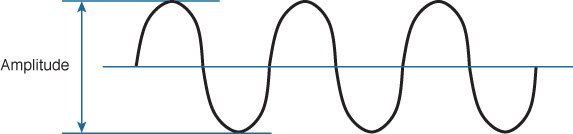
Other portions of a wave are wavelength, the measure of the physical distance that a wave travels over one complete cycle, and amplitude, the measure of the height from the top peak to the bottom peak of a signal's waveform.
This assignment was the most interesting to me because it got into the scientific details of a wireless network and the anatomy of the electromagnetic waves that allow it to operate, which I was not intimately familiar with before. Understanding these concepts on a more detailed level will allow me to make better decisions for hardware and topology when assembling wireless networks, which is vaulable information to my future and career.